Week 51 The penultimate week of my Calendar of Firsts.
That same story as the last few weeks, weatherise. Lots of rain and some frosty mornings. Breathtaking sunsets and sunrises. The Monday morning sky was half deep, but bright blue, half a glorious lilac-purple tone. The waning gibbous moon sat like a plump, cut diamond on a velvet cushion. We have a few sprigs of Mistletoe hanging in the hall way, so before I hung it up, I painted it and Rose cut open a berry to investigate the sticky insides.
And this is Christmas week! Such joy!
What’s happening in the natural world where you live?
Week 50! I am definitely on a countdown to the end of the year, and consequently, the end of my Calendar of Firsts.
Lots and lots of rain here again this week. And gorgeous sunsets and sunrises. I chose to paint the plump, ripe Ivy berries in the garden, and also the full ‘Moon before Yule’. It was quite a windy morning and the clouds were scudding along at quite a rate. We have also had some lovely Collar Doves visit the feeders this week, which was a joy.
What’s happening in the natural world where you live?
This morning we were reading The Christmas Book by Enid Blyton, a beautiful, living book, that details the customs and traditions of Christmas, tells the story of the birth of Christ, and tucks in a wee bit of nature study too.
We read the chapter about Holly, and picked some from our garden to study.
I have enjoyed dabbling with journals for many years, and way back when I was a newly-wed, I read a lovely book which suggested giving your journal a theme. The idea behind it was that exploring a theme would give your journal a strong focus to explore deeply.
I think this would be a lovely idea to explore a focused nature journal. Imagine how rewarding it would be to have a dedicated journal, whether it has been kept for a single month, or over several years.
I have been mulling over various ideas for themed nature journals, here are some I came up with. Please do let me know if you have any other ideas:
Your special nature place: Whilst it is interesting to visit as many different wildlife spots as possible, having a regular place for your nature study, enables you to really get to know this place and you will quickly become an expert on your own little corner of the world. Creating your own field guide would be treasure and an invaluable study.
A garden journal: Keep notes on the arrangement of your garden, what is planted and where, plus make space to record ideas and plans for future layouts. Record bloom times, fruiting times, harvest times, and general observations of your plants. Research the folklore associated with each plant, its traditional and medicinal uses. Explore non-synthetic pest control, keeping track of your success (or lack thereof!) in your journal. Keep notes on garden visitors; birds, insects, foxes, rabbits, and other mammals. Keep receipts and pertinent information of the provenance of your plants.
Tree Journal: You could choose to study one tree or several. Firstly establish the species. Is it a native tree? What lives in, on, and around your tree? Record when your tree blooms and fruits. When do the leaves change colour? What colours does it turn? What chemicals are the cause of these colours? Why is the folklore of your tree? What are the traditional uses for your tree? How tall is it? Measure its trunk circumference, take bark and leaf rubbings.
Weather Journal: Record the weather each day; measure and describe precipitation, temperature, wind direction and speed, cloud formations. Learn how to forecast the weather. Learn about weather folklore.
A bird journal: Sock your feeder well and record the visitors. Make notes or sketches of any birds you are unable to identify, then you can research later. Include times and dates, notes on the weather and also the food that attracted each bird. Record the bird’s behaviour and specifics such as size, colour and pattern, descriptions of the bill and feet / legs, the call it makes. Note also the courting and mating behaviour, nesting activity, winter residents, summer migrants, nesting behaviour, and how many broods are produced.
Rocks and minerals journal: Rocks are composed of minerals and are grouped into three categories:Igneous (volcanic) rocks Sedimentary (layered) rocks Metamorphic rocks (rocks that have changed over time.)
Minerals are naturally occurring, inorganic solids, with definite chemical compositions.
What rocks and minerals are you able to find in your own locality? Create sketches in your journal, record textures and colours, make maps of the locations of what you find. Draw thumbnails of sketches viewed through a lens or microscope. Investigate the history of your nature spot; was it once a mining area? How does this now affect the locality? Research the uses of the rocks and minerals you find.
Wild flower journal: This could be arranged by month of the year, or flower type, or by colour. Whatever appeals to your way of thinking. Record which are native flowers, which flowers that are classed as weeds (often the most lovely!) Research the folklore and Latin name (Officinalis denotes plants traditionally used in medicine and herbalism.) Make many sketches, take measurements, record colours and textures, include photographs and pressings.
It is a capital plan for the children to keep a calendar–the first oak-leaf, the first tadpole, the first cowslip, the first catkin, the first ripe blackberries, where seen, and when. The next year they will know when and where to look out for their favourites, and will, every year, be in a condition to add new observations. Think of the zest and interest the object, which such a practice will give to daily walks and little excursions.
Charlotte Mason
I hope this is helpful & gives you some food for thought. Happy exploring!
Week 49! I cannot quite believe I have only three pages left to complete in my Calendar of Firsts.
Unfortunately I have not been able to carve out time to make another video, and as we head toward Christmas, I see that becoming even less likely. I am hoping to create a video showing a flip though my journal after Christmas.
Lots of rain here this week. (Forgive me, I am English and our main preoccupation is weather.) Mornings are either warm and damp, or cold and dry, the latter being much more preferable! The feeders have been very busy, and we have had wee flocks of Starlings. I found this bird such a challenge to paint, and whilst I am not entirely happy with my sketch, I did get to observe this bird such a lot whilst working in my journal. Which is largely the point of nature journaling, is it not.
I have also noticed lots of moss over the last few weeks, so I added a quick sketch of the rather unimaginatively named ‘Ordinary moss’.
What’s happening in the natural world where you live?
I know many of you would like to start nature journaling. It’s really very simple; go for a walk, or look out of your window, and simply begin to sketch. Sometimes though, it is good to have a little more direction, so here are some ideas to get you going:
Begin a plant study, observe it for an entire year and record its changes. This could be a wildflower, tree, shrub, or plant growing in your garden.
Study the sky, the movement of the sun, sunrise and sunset times, and the hours of daylight, the position of the stars, and cycle of the moon.
Keep a nature journal all about your garden. Record what grows when, plan your dream vegetable patch, include layouts, sketches of plants, photographs. This will be a useful resource and a great treasure.
Spend 15 minutes a day watching your bird feeder. Record who visits and when. Follow up with studies on the individual birds.
Record the weather. Cloud shapes, precipitation, wind direction and speed.
I hope this helps to give you some ideas. If you would like a regular nature study companion, you may find my book Exploring Nature With Children to be useful. A complete, year-long curriculum designed to guide you, step by step, through an entire calendar year of nature study. Completely self-contained, this book has all the information you need to make nature study happen regularly for your family.
This week’s sketching took a festive turn as I decided to sketch our Christmas tree.
Norman Firs are probably the most popular Real Christmas Tree in the UK. It has gorgeous deep green foliage, with the underside a striking blue, and is very much the traditional ‘Christmas tree’ shape we have come to expect. Christmas tree day is such a special day in my home, I wanted to capture a little of that in my nature journal.
The weather here has been either heavy rain, or crisp, frozen, sunshiny days, with glorious sunrises & sunsets. The birds have been filling up at the feeders in my garden; Sparrows, Blue tits, Great Tits, Coal tits, Starlings, Blackbirds, and our wee Robin. I have an huge Holly tree in the garden and the Blackbirds are going a grand job of eating all its berries.
What’s happening in the natural world where you live?
Last year I wrote a guide for Christmas Gift Ideas For Nature Loving Children. This year, I wanted to share ideas for a broader age range of nature lovers. I hope it helps to give you some ideas for nature-inspired gifts.
We are a diverse bunch here at Raising Little Shoots, with readers from around the globe. I have chosen different ideas from both the UK and US to try to make the selections more easily available.
Silverpebble: Beautiful, nature-inspired, fine silver jewellery, made to order. Emma also offers jewellery-making working workshops around the UK. UK
SamOsborneStore: A gorgeous, 2017 wall planner with seasonal illustrations. UK
BijouxMalou: Pretty Orthoceras fossil necklaces on long, bronze chains. UK
The lost art of reading nature’s signs: A smashing wee book with techniques for forecasting and tracking, and for walking in the country or city, along the coast, and by night. This is the ultimate resource on what the land, sun, moon, stars, plants, animals, and clouds can reveal. US
Dorota Jewelry: A stunning nature pendant necklace features a genuine maple leaf, preserved in its natural form by electroplating with Sterling silver. US
TanglewoodHollow: Gorgeous, nature-based education materials created by a fellow home educating mother. Some are downloadable products, all can be shipped worldwide. US
An early watercolour sketch. My perspective for the chimneys was way out, and I could not at all represent the sky. So frustrating!
I get a lot of feedback from readers via emails, comments on the blog, and via the Facebook group about how inspired they are to keep nature journals, not only for their children, but also for themselves. This makes me so very happy!
Another early sketch. Coloured pencils are easier than that awful watercolour!
I really do believe that keeping a nature journal enriches our lives in so many different ways. For me personally keeping a nature journal brings me so much closer to the natural world around me; I notice things in both a macro and micro sense. I am much more aware of the seasonal changes, of changes in the sky, both day and night. I see the tiny details of whatever I happen to be sketching, details that would have ordinarily passed me by. Details that I do not see when I photograph a subject, or look at it just for pleasure. Nature study brings me closer to my Creator, and for that, I am forever thankful.
But coloured pencils take f-o-r-e-v-e-r !
I also, unfortunately, sometimes receive messages or comments from people who feel that they cannot keep a nature journal because they “cannot draw”, or their drawings are “not good enough”
Working more quickly with pencils
This makes me feel so sad, and so frustrated! There seems to be a myth that people can either draw or they cannot. This is so wrong! Would we tell a child who was struggling to read, “well, some people are born readers, others aren’t” No! We would teach them the rules, insist they practice by reading many, many books. It is the same with drawing.
Teaching myself dry brush watercolour by copying the paintings of Edith Holden from The Country Diary Of An Edwardian Lady
I am not saying that some people don’t have a natural talent, but they still have to work at it, spending many many hours, months, and years perfecting their work, learning new skills.
Learning that dry brush can take quite a while too…
Nature study is so much more than creating beautiful images. It really is in the journey, not the end product (though of course, we all enjoy the satisfaction of producing a lovely end piece!) But as we learn to draw (and of course, the only way to learn to draw is to actually draw!) we can still be learning about our subject, even if our finished piece is not what we would like, or bears no resemblance to what we have been sketching!
Finding my own style
As we sketch, we observe each and every little detail. This is in fact the key to sketching success; learning to see. Sketching what you actually see, not what you think you see.
Loose & splashy!
I have also been told that my work is too ‘arty’ for a nature journal. There are not enough notes, or that my work isn’t precise enough. I think that we must create our journals for ourselves. Comparison really is the thief of joy. I do not have the skill to paint photo realistic work. Nor do I have the time! But I have come to a place of peace, knowing that the journal pages I create each bring me closer to a subject I want to learn about and a Creator whom I love.
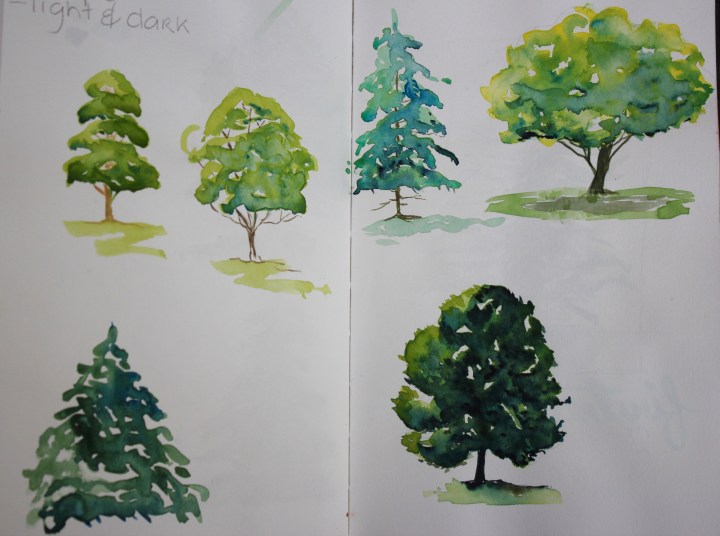
Some pages I am pleased with, such as this page of trees:
Experimenting with light & shade
Others not so much! But I learn a lot from these ‘mistakes’.
Oh dear!
We must keep trying. We must be prepared to invest time and be prepared to fail.
Recent landscapes:
The good..the bad…and the ugly!
Let’s stop comparing our work, encourage one another in our endeavours, and keep learning.
Always learning
“It is only what we have truly seen that we can truly reproduce; hence, observation is enormously trained by art-teaching.”
This week I have sketched a Magnolia branch from my garden. We have two Magnolia trees, and this one always loses it’s leaves first. It is full of buds and literally only a couple of leaves are left, whilst the other tree is still full of golden leaves. I also sketched the sliver of waning moon from Friday morning. Everything was covered in frost; the air was cold and still. Jupiter was lined up so beautifully with the moon.
Weather-wise, we have had heaps and heaps of rain, along with a few perfect, late autumn, golden, frosty days.
What’s happening in the natural world where you live?


 I hope this is helpful & gives you some food for thought. Happy exploring!