Painting A Toad In My Nature Journal

IMG_7019.jpg

My Calendar Of Firsts this week featured some of the things we saw on our ‘moon walk’ a few evenings ago; the Harvest Moon, a hunting owl, and a toad.

You can see me painting the toad in this week’s video.

The supplies I used:

Moleskine diary

Fountain Pen with waterproof ink

Da Vinci 1503 size 8 watercolour brush

Watercolours:

  • Quinacridone Gold
  • Ultra Marine (green shade)
  • Phtalo Blue
  • Indigo
  • Cadmium Yellow Light

This is  just a short video to share how I work. I would love to hear how you create.

I have recently created a private FaceBook group for home educating families to encourage one another in our journaling pursuits. It would be lovely to see you there.

The Charlotte Mason Nature Journaling FaceBook Group

Painting A Dandelion In My Nature Journal

img_6776

The supplies I used:

Moleskine diary

Fountain Pen with waterproof ink

Da Vinci 1503 size 8 watercolour brush

Watercolours:

  • Naples Yellow
  • Winsor Orange
  • Cobalt Blue
  • Ultra Marine (green shade)
  • Phtalo Blue
  • Cadmium Yellow Light
  • Quinacridone Gold
  • Quinacridone Magenta

This is  just a short video to share how I work. I would love to hear how you create.

I have recently created a private FaceBook group for home educating families to encourage one another in our journaling pursuits. It would be lovely to see you there.

The Charlotte Mason Nature Journaling FaceBook Group

Painting Raspberries In My Nature Journal

IMG_6550.jpg

The supplies I used:

Leuchtturm 1917 sketchbook

Fountain Pen with waterproof ink

Da Vinci 1503 size 8 watercolour brush

Watercolours:

  • Naples Yellow
  • Raw Sienna
  • Cobalt Blue
  • Ultra Marine (green shade)
  • Cadmium Yellow Light
  • Quinacridone Magenta
  • Naphthamide Maroon

White Gel Pen for highlights

This is  just a short video to share how I work. I would love to hear how you create.

I have recently created a private FaceBook group for home educating families to encourage one another in our journaling pursuits. It would be lovely to see you there.

The Charlotte Mason Nature Journaling FaceBook Group

Painting An Apple & A Strawberry Leaf In My Nature Journal


This week I have two videos for you!

The supplies I used:

Moleskine diary

Fountain Pen with waterproof ink

Da Vinci 1503 size 8 watercolour brush

Watercolours:

  • Cadmium Yellow Light
  • Raw Sienna
  • Cobalt Blue
  • Ultra Marine (green shade)
  • Quinacridone Magenta
  • Cadmium Red

These are just just a short videos to share how I work. I would love to hear how you create.

I have recently created a private FaceBook group for home educating families to encourage one another in our journaling pursuits. It would be lovely to see you there.

The Charlotte Mason Nature Journaling FaceBook Group


Painting Ripening Tomatoes In My Nature Journal

IMG_5722.jpg

Hello everyone! I have a new video up on YouTube:

The supplies I used:

Moleskine diary

Fountain Pen with waterproof ink

Da Vinci 1503 size 8 watercolour brush

Watercolours:

  • Cadmium Yellow Light
  • Raw Sienna
  • Cobalt Blue
  • Ultra Marine (green shade)
  • Quinacridone Magenta
  • Cadmium Red
  • Winsor Orange

This is just a short video to share how I work. I would love to hear how you create.

I have recently created a private FaceBook group for home educating families to encourage one another in our journaling pursuits. It would be lovely to see you there.

The Charlotte Mason Nature Journaling FaceBook Group

The 20% discount for Exploring Nature With Children expires on August 20th, so please use code EXPLORE before it is gone!


Painting A Conker In My Nature Journal

watercolour conker in my nature journal.jpg

I have created a new video!

The supplies I used:

Moleskine diary for the original sketch

Fountain Pen with waterproof ink

Da Vinci 1503 size 8 watercolour brush

Watercolours:

  • Buff Titanium
  • Cadmium Yellow Light
  • Cobalt Blue
  • Raw Umber
  • Quin Gold
  • Windsor Orange

The Charlotte Mason Nature Journaling FaceBook Group

This is just a short video to share how I work. I would love to hear how you create.

Painting In My Nature Journal

DSC02827.jpg

I recently shared my Calendar of Firsts on the Ambleside Online Facebook Group.

Some of the ladies there asked if I would make a video of how I use my watercolours, so, drum roll please, here it is!

The original sketch I shared is above, and here is the copy I did for the video

DSC02826.jpg

The supplies I used:

Moleskine diary for the original sketch

Leuchtturm 1917 sketchbook for the copy

Fountain Pen with waterproof ink

Da Vinci 1503 size 8 watercolour brush

Watercolours:

  • Buff Titanium
  • Moonglow
  • Indigo
  • Ultramarine (G)
  • Cobalt Blue
  • Shadow Violet
  • Permanent Rose
  • Naphthamide Maroon
  • Piemontite Genuine
  • Potter’s Pink
  • Cadmium Yellow Light

White Gel Pen for highlights

This is just a short video to share how I work. I would love to hear how you create.


Nature Journaling Supplies ~ Revisited!

I recently shared with you my updated nature journaling supplies.

Already I have fussed around and changed them! It was more the method of organisation than the supplies themselves, but seeing as I love to look at how others organise their supplies, I thought it would be fun to share mine.

w1

First off here is my new daypack; the other was very old and tatty. This is a child’s pack, so not too big, which is great as it is always tempting to pack more stuff.

w2

Water for painting with

A tiny atomiser filled with clean water for spraying over my paints to get them nice & juicy before I begin to paint.

A genius, foldable pouch for pouring your water into (I stand the bottle in the pouch, to avoid the water blowing away on windy days!)

w3

First Aid kit

w4

It contains:

Antiseptic spray

Sun cream

Bite / sting lotion

Antibacterial gel

Bug repellant (I made this myself, it is just a blend of essential oils in a coconut oil base)

Plasters

w5

Small sandwich box (to collect small nature treasures)

Hand wipes

w6

A large pencil case stores the following:

Watercolours

Tissues for blotting

Paperclips to hold open my journal

Tin of supplies:

w7

w8

Prismacolor pencils in white & black grape (useful for sketching and asking highlights / shadows)

4B pencil 

2B pencil 

Platinum carbon ink pen My favourite pen! Oh, how I love this one! Reliable, waterproof, deep black ink. Never lets me down.

Derwent watercolour pencil in blue grey I have added a nice new one to my kit. Smashing for sketching, then painting over with watercolour. Gives a lovely effect

White gel pen Perfect for adding small highlights to finished watercolours.

Cross mechanical pencil (not quite the same as mine, but similar) Fantastic, as it never needs sharpening!

Versatil round pointed brush Great for tree branches & fine details. A smashing, well-priced, synthetic brush.

Da Vinci 1503 size 8 watercolour brush A beautiful brush, with an exquisite point. Pretty much the only brush I use in my journal.

An old brush. Used for splatters & scrubbing out colour. It is also sharpened at the other end, so I can use it to scrape out colour when dried, or scrape in twigs etc.

Ruler. Useful for measuring specimens out in the field.

Birthday candle. Perfect for keeping white highlights in your watercolour, due to its resist properties.

Penknife For cutting wee plant specimens.

Kneadable Eraser. These are smashing! You can shape them to the smallest point to erase tiny details, or add highlights to a pencil sketch. Knead after use to avoid build up of colour from the pencil.

Cut up credit / key card. Again, useful for scraping in twigs and so forth.

Tiny chunk of sea sponge Useful for creating texture in foliage, rocks etc.

w9

Water colour palette. Mine is a Schmincke, to which I have added Winsor Newton & Daniel Smith paints. My current colours:

w12

NB. I have removed the Napthamide Maroon & replaced it with my much needed Raw Sienna.

w10

Field Guide This is a smashing guide that we have used on and off for years.

w11

A journal – this one is My newest journal, a Stillman & Birn Alpha Sketchbook which I am using to practice new techniques and such. A smashing journal, the paper is wonderful; it takes a wet wash beautifully & has a nice tooth, but still works well when writing in ink.

I also use:

101010

My regular nature journal.  I am currently using the Leuchtturm 1917 sketchbook in medium (A5). The paper is a decent weight, and very smooth, however the paper is really too thin for watercolour, so I have found that once I have completed my painting & it is dry, I miss a page, & glue them together, so I get a double weight of paper.But I like the journal a lot, and am enjoying using it.

UPDATE: I actually really love this journal, and having finished this one, I have moved on to another, but this time I am not glueing the pages together. It isn’t perfect; if I use a particularly juicy wash, it bleeds through the page, but I love the crisp white of the paper & it holds up to most of my pen & ink and watercolour washes.

1212121

My Calendar of Firsts. A Moleskine diary, the paper is, as always with the Moleskines (except the specialist water colour book) not great for watercolour, but I am used to how the paper takes the wetness of the media & this book is doing exactly what I need it to do; record what is happening in nature in simple sketches. The fact that it is such a ‘casual’ book makes it easier for me to sketch in hasty sketches; I don’t feel bad about messing up!

I hope that is of some interest! Please do share your own supplies & packing tips in the comments!

Happy exploring

Lynn


Nature Journaling Supplies

ss.jpg

I have recently reorganised my nature journaling supplies; I changed a couple of things, and replaced a couple of battered items. I thought it would be fun to share with you my current set up.

I have moved everything into this handy travel bag by Winsor & Newton, as the bag I was using previously was no longer working for me.

The travel bag comes with some supplies I don’t use, such as a Cotman palette, watercolour pad, and two brushes. This is a great set for someone new to nature journaling.
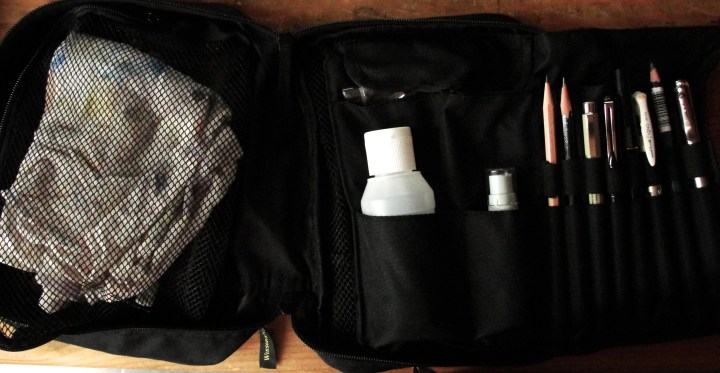
s1

Here is the bag when opened out. It also has another couple of storage sections on the reverse side. I love all the pockets! So useful.

In the left hand side mesh pocket, I keep the following items:

s2

An old muslin cloth from when the girls were babies. Very useful for wiping my brushes on!

A colour wheel. Something I always intend to use, but never end up doing! Helpful for colour mixing, or perhaps planning colour schemes for watercolour paintings.

Ruler. Useful for measuring specimens out in the field.

Birthday candle. Perfect for keeping white highlights in your watercolour, due to its resist properties.

Clips. Fantastic for keeping journal pages open on a windy day.

Penknife For cutting wee plant specimens.

Water brushes Great for painting on the go; the barrels are filled with water, which you squeeze to gradually release a supply of water into your paint, so no need to carry an additional water supply.

Kneadable Eraser. These are smashing! You can shape them to the smallest point to erase tiny details, or add highlights to a pencil sketch. Knead after use to avoid build up of colour from the pencil.

s4

The other side of the travel bag includes a water bottle and a genius, foldable pouch for pouring your water into (add a small, clean rock to the bottom when painting in the field, to avoid your water blowing away on windy days!)

Spray bottle I use an old, travel sized facial mist bottle, refilled with water to spray my watercolour paints to get them nice and juicy before I begin to paint.

s5

My current pens and pencils:

2B pencil that came with the travel case.

4B pencil 

Micron permanent ink pen

Pentel brush pen I have to say that I never actually use this. One day!

Platinum carbon ink pen My favourite pen! Oh, how I love this one! Reliable, waterproof, deep black in. Never lets me down.

White gel pen Perfect for adding small highlights to finished watercolours.

Derwent watercolour pencil in blue grey I have added a nice new one to my kit. Smashing for sketching, then painting over with watercolour. Gives a lovely effect.

Cross mechanical pencil (not quite the same as mine, but similar) Fantastic, as it never needs sharpening!

s3

Water colour palette. Mine is a Schmincke, to which I have added Winsor Newton & Daniel Smith paints. Look at the entry in my journal below for my current colours.

s8

Da Vinci 1503 size 8 watercolour brush A beautiful brush, with an exquisite point. Pretty much the only brush I use in my journal.

Versatil round pointed brush I rarely use it, but it does come in handy sometimes for fine details. A smashing, well-priced, synthetic brush.

s6

Field guide I am carrying this New Holland pond guide at the moment, as our two favourite places for nature study have ponds. Great little guide book.

Month -by-month Stargazing 2016 A concise guide to the northern-hemisphere night sky.

Nature Journal I currently have three journals on the go, so choose whichever is appropriate, and tuck it into my travel case as I head out of the door.

s7

My newest journal, a Stallman & Birn Alpha Sketchbook which I am using to practice new techniques and such. A smashing journal, the paper is wonderful; it takes a wet wash beautifully & has a nice tooth, but still works well when writing in ink. You can see here my current palette set up.

J3

My regular nature journal.  I am currently using the Leuchtturm 1917 sketchbook in medium (A5). The paper is a decent weight, and very smooth, however the paper is really too thin for watercolour, so I have found that once I have completed my painting & it is dry, I miss a page, & glue them together, so I get a double weight of paper.But I like the journal a lot, and am enjoying using it.

cal3

My Calendar of Firsts. A Moleskine diary, the paper is, as always with the Moleskines (except the specialist water colour book) not great for watercolour, but I am used to how the paper takes the wetness of the media & this book is doing exactly what I need it to do; record what is happening in nature in simple sketches. The fact that it is such a ‘casual’ book makes it easier for me to sketch in hasty sketches; I don’t feel bad about messing up!

Please share what is working for you, either in the comments below, or on the Exploring Nature With Children FaceBook page.

Happy exploring!


Lectio Divina And Expanding Nature Study

20130826_092538

“Lectio Divina” is a Latin term for the Christian practice of “divine reading”, a way to read the scriptures, meditating upon them, and moving forward in prayer. The reader is changed by this deep and powerful experience; but what has this to do with nature study?

These three stages of learning are reflected through many ideas of education. They are a truly wonderful way to approach nature study. Let us look at the three stages of Lectio Divina and how we can bring these ideas to the study of nature.

  • Reading ~ Observing

2

When studying nature, this would be the stage at which we closely observe. Like the grammar stage of The Trivium, we are learning the facts about our subject. We spend time closely observing nature, learning, reading books and field guides and building up a store of knowledge about our subject.

In our nature journals, this may look like:

Key facts such as the location, date, time of day or night.

Brief notes on the weather.

We may make quick sketches to capture what we see, notes at the sides of our sketches to help us remember key details, such as notes on textures, position etc.

Latin names of subjects

Measurements

Photographs

  • Meditating ~ Thinking

1

This is such an important step in nature study; not to be rushed or missed by the harried parent! Reflecting upon what we have learned, making our own connections, thinking critically is important to building a relationship with, and understanding, the natural world around us. How does all that we observed in stage one fit together? This would be the logic stage within The Trivium.

In our journals we may make notes on connections; ‘what does this remind me of ?’ I would strongly urge you to read this blog post by naturalist John Muir Laws: Prompts For Deeper Nature Observation. His questions, I notice, I wonder, It reminds me of, are wonderful, thought provoking tools.

  • Praying ~ Responding

9

The final stage is our response to all we have learned and discovered. We have been changed by our experiences and have a need to communicate and express that. We cannot do this stage well, or authentically, without the building blocks of the previous stages, like the Rhetoric stage in The Trivium.

Our nature journals are the perfect place to respond; we may choose to:

Create more intricate, fully formed paintings or drawings of the focus of our nature study.


An arrangement of pressed flowers or leaves

Quotes that pertain to the subject

Passages of scripture

Poetry; either written by ourselves in response to our wonder at the focus of our studies, or poetry written by another, that our heart connects with.

Lists – insects, wild flowers, mammals, trees, whatever appeals to the journal keeper.

These stages are not fixed rules, but an oft-practiced pattern to mark the way as we progress in our journaling of the natural world, and enter into a deeper relationship and knowledge.

1

Happy exploring!