

Children Should Be Encouraged

Happy Weekend!

Nature journaling is an immensely rewarding pursuit for both parent and child. In Charlotte Mason’s own words:
Consider, too, what an unequalled mental training the child-naturalist is getting for any study or calling under the sun — the powers of attention, of discrimination, of patient pursuit, growing with his growth, what will they not fit him for?
Home Education Vol. 1, p. 61
Today I would like to share with you my top five tips to help you in keeping a nature journal.
There are so many different sketchbooks and journals on the market, it can be really quite confusing. The main points to consider would be:
Paper texture and weight
Choose the paper, according to the media you will be using in your journal.
Hot-pressed paper has a very smooth surface. This is actually the paper in my current journal. It is great for writing on, and using with coloured pencils, but tends to not be that great with watercolour; the paint can be quite difficult to control.
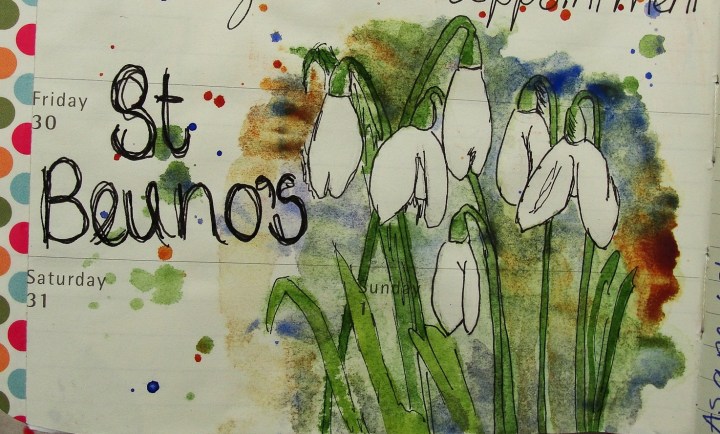
Cold-pressed paper (sometimes referred to as Not paper) has a more versatile, slightly ‘toothy’ surface which will work well with both ink, coloured pencils, and light watercolour washes.

Lastly, there is Rough paper, which has a much ‘toothier’ surface & will cope with lots of lovely, juicy paint.

Paper is a very personal preference. I often use quite wet washes in my journals, but often the paper I favour is extremely smooth, which makes no sense at all!

Play around with different papers to get a feel for what you and your child prefer to work on, but if you are starting out, I would suggest going for a cold-pressed paper to begin with, as you experiment with different media.
The thickness of paper is indicated by its weight, and is measured either in grams per square metre (gsm) or pounds per ream (lb).The papers that are most frequently used tend to be:
90 lb (190 gsm) Found in many sketchbooks, may buckle with a watercolour wash.
140 lb (300 gsm) Tends to be used for finished watercolour paintings, but will still buckle if not taped down
300 lb (638 gsm) Extremely heavy-weigh paper. does not buckle
Journal size & shape
Journals are available in all shapes & sizes, from tiny, palm-sized sketchbooks, through to huge 24″x36″ affairs! Usually rectangular, in either portrait or landscape formation, they can also be found in a square format. Try to buy from an art shop if possible, rather than online, then both you and your child can hold the books in your hands to see which feels most naturally comfortable. Your preferences may change as you progress in your nature journaling journey.
Binding
Wire bound or hardbound is again a personal preference. I find the wire bindings get in my way, however wire bound books have the ability to lay the book flat with ease, or fold the covers back completely.

Do not let yourself or your child be caught up in creating the ‘perfect’ nature journal page (whatever that may be!) Keep in your mind the thought that nature study is science rather than art, it may help a little! Observe closely and record what you see, not what you think you see.
Often people feel very nervous beginning a new journal. The pressure of the first blank page! Many journalers leave the first couple of pages blank, and begin with their first entry on the second, even third page. You can go back and work on that first page another time, or use it for lists, such as local wildflowers, birds, daily temperatures, or use the first page as a testing space for new paint colours, pens or coloured pencils.

If something goes awry in your journal, please don’t ever tear out a disappointing page from your journal. Everyone has them and tearing it out will weaken and damage your book. Instead, there are other possibilities. Learn how to correct the mistake; what went wrong, how can it be fixed? Making mistakes is the fastest way to progress in learning something new. You could simply begin a new sketch right there on the page with the old one. Or, if worst comes to the worst, stick a photograph, seed packet, or clipping from a wildlife article of the offending page. Just never tear out a page. Never give up on your journal, and it will never give up on you!

Here are some details that are helpful to include in your journal:
Basic entries:
• The location
• Date
• Time of day (or night!)
• A brief note on the weather. I usually draw a small rectangle next to the above details and make a quick sketch to represent the weather, rather than writing about it.
• Once you have sketched your subject, be sure to label it, though this may need to wait until you have looked up your subject in your field guide.
More advanced ideas:
• Latin names of subjects
• Diagrams
• Notes on sketches – you may want to include further details, such as notes on textures, or position etc.
• Measurements
• Pressed flowers or leaves
• Photographs
• Quotes
• Passages of scripture
• Poetry – use the weekly poems as a starting point.
• Photographs
• Lists – insects, wild flowers, mammals, trees, whatever appeals to you, the journal keeper.

Please do not get overwhelmed at this point. The essence of nature journaling is to get out of doors, observe and then sketch something in nature, label and date the sketch. That’s it! If you do this consistently, you cannot help but to learn about the world around you and improve your own recording / sketching skills. If you would like ideas of what to study on a seasonal basis, with all the information you need for basic study, please take a look at my book Exploring Nature With Children. It has helped many, many families make nature study happen on a regular basis.
Dare I suggest daily? The benefits of regular nature study are many;
Learning about the natural world around you
Spending just five to ten minutes a day observing nature is all you need to build your local knowledge. Can’t find time daily? Try just once a week. It is the regularity that will make the difference, noticing the changing seasons, the movement of the sun in the sky, the shape of the moon, when the apple tree blossoms, and so forth.

Connection the the natural world

The formation of habit
“The habits of the child produce the character of the man.” Charlotte Mason
To reiterate what has been said above; the consistency of spending a small but regular time with your journals, out of doors will greatly improve the skills of both you and your child. Observing nature closely, and drawing what you see (not what you think you see) is essential to building drawing skills. And vice versa; drawing will build observation skills.
“It is only what we have truly seen that we can truly reproduce; hence, observation is enormously trained by art-teaching.” Charlotte Mason


I am often asked about getting started with nature drawing for both parent and child.

The best advice I can give for both parent & child is to simply draw.
Charlotte Mason knew what she was doing; observing nature closely, and drawing what you see (not what you think you see) is essential to building drawing skills. And vice versa; drawing will build observation skills.
“It is only what we have truly seen that we can truly reproduce; hence, observation is enormously trained by art-teaching.” Charlotte Mason

My firm belief is that everyone can draw. Of course, some will be more talented, or pick it up quicker, but there are rules we can learn, which when followed, produce authentic results.
Would we tell someone who cannot read that they do not have talent? We would show them step by step the keys to reading. I believe it is the same with art.
I wrote a guest post a couple of years ago for the Expanding Wisdom blog, that you may find helpful, all about learning the dry brush technique, which Miss Mason favoured.

I also have a tutorial on my own blog which is more my current, splashy, loose style, and takes you step by step to create your own journal entry.

You may also find these other posts to be of help:
Supplies For Nature Journaling
Setting Up Your Nature Journal
Not on sketching, but has useful ideas on nature study with children:
How To Study Nature With Children Of All Ages
I would also really recommend the following books by Claire Walker Leslie:
Nature Drawing. A Tool For Learning
I would also strongly recommend studying great works of art as part of a child’s education.
“We cannot measure the influence that one or another artist has upon the child’s sense of beauty, upon his power of seeing, as in a picture, the common sights of life; he is enriched more than we know in having really looked at even a single picture”
Charlotte Mason Vol. 1, p. 309
So again, as well as surrounding the child with beauty, it is the idea of the “power of seeing”, and “only what we have truly seen” that makes a difference.
Here is an excellent article on how to get started with studying art with your child.
Exploring Nature With Children is a smashing resource for making picture study happen regularly in your own home. It has the name and details of a famous work of art that relates to the nature topic being studied each week. The works of art are easily looked up online, or found in art books available from your local library.
There is one picture for each of the forty-eight weeks of nature study; four weeks for each month of the year, organised by season.
In conclusion, to learn to sketch, you have to sketch. We can read all the books, buy all the supplies, but in the end we have to get down to the task, and learn by doing, learn by our mistakes. Which can be pretty humbling! But I think it is great for our children, to see us struggle to learn something new. It is a great reminder to us of how our children feel when they are working to master a new skill. Also be sure to surround yourself and your child with beauty, both in nature and in art.
Small steps, small steps.
Happy Exploring!

In Charlottes own words:
In saying that “education is a life,” the need of intellectual and moral as well as of physical sustenance is implied. The mind feeds on ideas, and therefore children should have a generous curriculum.
You can see the summary of Charlotte Mason’s twenty principles of education here at Ambleside Online.
In Charlottes own words:
By “education is a discipline,” we mean the discipline of habits, formed definitely and thoughtfully, whether habits of mind or body. Physiologists tell us of the adaptation of brain structures to habitual lines of thought, i.e., to our habits.
You can see the summary of Charlotte Mason’s twenty principles of education here at Ambleside Online.

In Charlottes own words:
When we say that “education is an atmosphere,” we do not mean that a child should be isolated in what may be called a ‘child-environment’ especially adapted and prepared, but that we should take into account the educational value of his natural home atmosphere, both as regards persons and things, and should let him live freely among his proper conditions. It stultifies a child to bring down his world to the child’s level.
You can see the summary of Charlotte Mason’s twenty principles of education here at Ambleside Online.

Happy Weekend!